

Cables and hoses frequently have to go over walkways in factories, warehouses, construction sites, offices, and at event venues. If they remain exposed, they can become trip hazards and be damaged by foot traffic, trolleys, or equipment.
A cable protector covers exposed cables, helping create a more controlled crossing for pedestrians and equipment. Depending on cable dimensions and traffic conditions, a heavy duty cable protector may be appropriate.
For businesses choosing the right solution, it is not enough merely to cover a cable; the product has to fit the cables, be suitable for the working environment, and be capable of supporting the expected traffic.
Why Are Cable Protectors Important?
Cables that are exposed may block paths and be damaged as a result of repeated contact with shoes, wheels, tools, and machinery. In workplaces with constant movement, loose cables can put people at risk of tripping and leave electrical equipment vulnerable to damage.
OSHA’s walking-working-surface requirements address workplace hazards that can contribute to slips, trips, and falls. The UK Health and Safety Executive (HSE) recognizes trailing cables as a workplace trip hazard and recommends suitable cable management practices.
Using a suitable cable protector can help businesses:
- Where cables cross paths that people walk on, reduce trip hazards.
- Make sure that the cables and hoses remain in the designated channels.
- Limit exposure to abrasion, impact, and crushing.
- Improve cable arrangement in both temporary and permanent work areas.
- Lower the risk of accidental damage to the cable.
A cable protector constitutes a component of workplace safety, and proper cable routing, housekeeping, inspections, and other site-specific controls are still necessary.
How Does a Cable Protector Improve Walkway Safety?
1. Covers Exposed Cables:
A loose cable can result in an uneven surface that pedestrians might fail to notice. A cable protector surrounds the cable and provides a clear crossing point.
How effective it is will depend on its design, its dimensions, the nature of its surface, and its suitability for the type of traffic it is meant to handle. If it is possible, cables should be routed away from pedestrian walkways in order to eliminate the need for crossings of the floor altogether.
2. Keeps Cables Organized:
Cables may shift or spread out over a walkway if people walk on them or if equipment passes by. A cable ramp that is properly fitted includes channels that aid in keeping the cables in place and help to maintain a more organized crossing.
Prior to installing them, make sure that the cables can fit into the channels without being excessively compressed and that the protector stays stable when in use.
3. Helps Prevent Cable Damage:
Constant pressure, rubbing, and impact can cause damage to the insulation of a cable. The electrical wiring requirements set out by OSHA are concerned with the need to protect flexible cords and cables from accidental damage.
A cable protector helps address these risks by covering exposed wires and shielding them from external pressure or impact. The protection provided depends on its material, design, channel size, and maximum load capacity. However, it does not eliminate all possible risks; therefore, any damaged cables should be examined and dealt with in accordance with the relevant electrical safety procedures.

4. Supports High-Traffic Applications:
Warehouses, loading areas, manufacturing plants, and places where events take place may see a lot of pedestrian and equipment activity. Products having to meet greater loading requirements may be needed in such environments.
A cable protector that is described as heavy-duty could be the appropriate choice in cases where high loads or frequent traffic are involved. The term “heavy duty”, though, does not define a particular load capacity.
Choosing the right product requires checking the manufacturer’s stated ratings. Some protectors are designed for foot traffic, while others can accommodate trolleys, pallet jacks, forklifts, or vehicles. Choose a cable protector that can safely withstand the type of traffic expected in the area.
5. Makes Cable Crossings Easier to Identify:
Routing cables through a designated crossing point also makes them easier to identify and manage than cables left loose on the floor. Using a contrasting color can further improve visibility in busy workplaces.
Lighting, signage, access, and any further changes in floor level should still be taken into account. A cable protector must not create a new obstruction and should not be regarded as a replacement for other necessary safety controls.
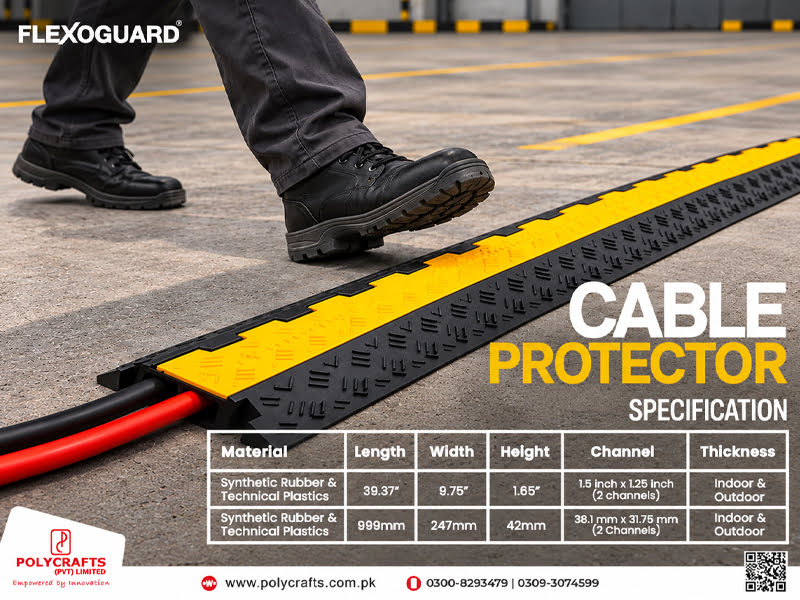
Polycrafts Rubber Cable Protector: Technical Specifications
Polycrafts’ rubber cable protector is described with the following specifications:
| Specification | Stated details |
| Material | Synthetic rubber and technical plastics |
| Length | 1,000 mm |
| Width | 248 mm |
| Height | 45 mm |
| Channel dimensions | 32 × 32 mm |
| Intended environment | Indoor and outdoor applications |
Before placing an order, the details should be cross-checked with the most up-to-date product datasheet; in particular, the number of channels, the maximum load rating, the surface grip, the method of connection, and the types of traffic that are permitted should all be verified. The details in question cannot be determined solely from the dimensions.
When installing it, measure the cables and check the amount of floor space available. For safe use, the protector must fit properly, stay in position, and avoid creating an additional obstacle for people walking through the area.

What to Check Before Installing a Cable Protector
Before you select or install a product, evaluate the crossing. To do this, first determine the type of cable, its dimensions, the number of cables, and the expected amount of pedestrian or equipment traffic.
Now let’s look at the environment since moisture, dust, chemicals, temperature variations, and exposure to outdoor conditions may influence the suitability of the product. You should check with the manufacturer about any relevant material limitations.
Last of all, check the finished installation to make sure that the cover is stable, the cables are not too tightly compressed, and the crossing does not block access or emergency routes. If any risks still remain, then consider using an alternative route, installing barriers, putting up signage, or taking other suitable measures.
How to Choose the Right Cable Protector
Before purchasing, buyers should consider:
| Selection factor | What to check |
| Cable dimensions | Compare cable or hose measurements with the channel dimensions. |
| Number of cables | Confirm the available channels can accommodate the required cables. |
| Traffic type | Identify pedestrian, trolley, pallet jack, forklift, or vehicle use. |
| Load capacity | Match the published load rating to the expected application. |
| Environment | Check suitability for moisture, chemicals, temperature, and UV exposure where relevant. |
| Installation | Confirm stability, joining arrangements, and suitability for the floor surface. |
Such inspections aid in avoiding the selection of a product which is too small, not suitable for the environment, or one that cannot endure the anticipated load.

Cable Protection Solutions from Polycrafts
Polycrafts offers rubber products for a range of commercial and industrial environments. When businesses are dealing with exposed cables, selecting an appropriate cable protection solution can aid in organizing the routes of the cables, reduce the amount of everyday physical damage, and result in more controlled crossings over walkways.
When choosing a cable protector, a cable ramp, or a heavy duty cable protector, you should base your decision on the real dimensions of the cable, the conditions regarding traffic, and the manufacturer’s specifications rather than just the name of the product.
Contact Polycrafts with your cable measurements, number of cables, installation environment, and expected traffic. These details can help identify a suitable product for your application.
Frequently Asked Questions
What is a cable protector?
With the right cable protector in place, exposed cables can cross busy floors more safely, reducing the likelihood of trips and helping prevent wear, crushing, and other forms of physical damage.
Where are cable protectors commonly used?
They find use in warehouses, factories, construction sites, offices, event venues, and other places where cables run over paths used by pedestrians or areas where equipment is located.
When should I use a heavy duty cable protector?
It should be considered in cases where higher loads or frequent traffic is involved. Before using it with wheeled equipment or vehicles, you should check the manufacturer’s specified load rating and the types of traffic that are permitted.
How do I choose the right cable protector?
Check cable dimensions, channel capacity, traffic type, load rating, environmental conditions, and installation requirements. Confirm any unresolved technical details with the manufacturer.
Safety References:
- OSHA, 29 CFR 1910.22: General Requirements for Walking-Working Surfaces
- OSHA, 29 CFR 1910.305: Wiring Methods, Components, and Equipment for General Use
- UK Health and Safety Executive, Slips and Trips: Hazard Spotting Checklist